
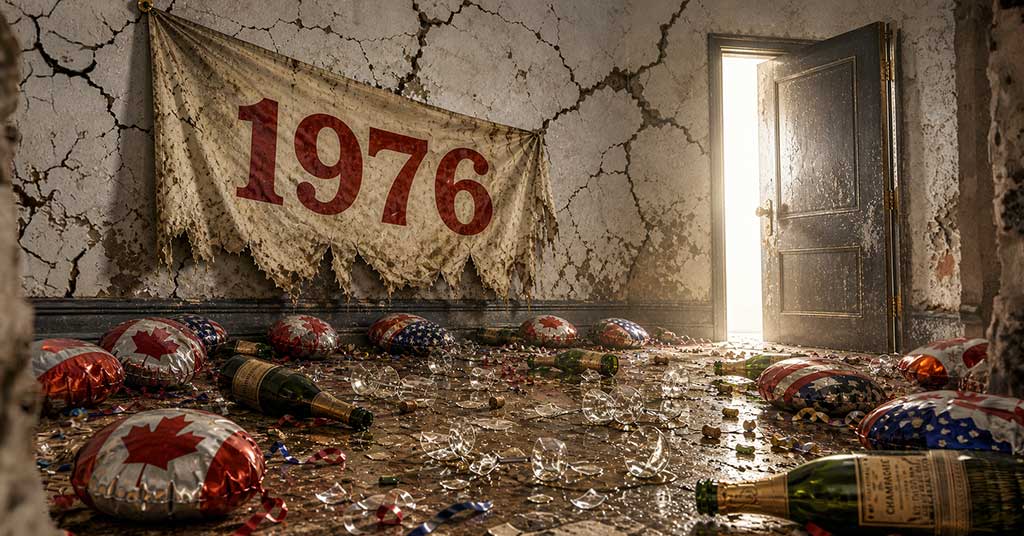
From the rise of U.S. presidential outsiders to the PQ win in Quebec, 1976 haunts us still
With the United States marking its 250th birthday, my mind goes back 50 years to the 1976 bicentennial celebrations. Despite the hangover from Watergate and the Vietnam War, the degree of polarization at the time bore no resemblance to the situation today. Strong differences of opinion notwithstanding, it was still very much a united country proudly celebrating its history.
It was also a presidential year.
Senator Edward Kennedy was by far the most prominent Democrat nationally but he was still tainted by the events at Chappaquiddick that had precluded any possibility of a presidential run in the previous 1972 cycle.
Into the void stepped a fresh face, Jimmy Carter. Little known outside his native Georgia, Carter presented himself as a breath of fresh air—honest, unpretentious, and completely unspoiled by the nefarious machinations associated with Washington, D.C. Unmistakably southern and the media-proclaimed symbol of the New South, he offered the prospect of electoral success in states that had started to drift towards the Republicans in presidential elections. (He ultimately delivered on that promise in the general election, becoming the first Democrat to carry every state in the Deep South since Franklin D. Roosevelt in 1944.)
Meanwhile, the Republican contest saw a sitting president strongly challenged by a charismatic insurgent.
Gerald Ford was truly an accidental president. Appointed vice-president when Spiro Agnew resigned in disgrace, he assumed the presidency after Richard Nixon bowed to the Watergate-derived inevitable in August 1974.
However, Ford’s ascension was a tribute to Nixon’s political enfeeblement and Democratic dominance in both the House and the Senate. Prior to Agnew’s resignation, Ford was on nobody’s list as a prospective Republican presidential nominee. But he was the relatively innocuous best that Nixon could push through the requisite confirmation process.
In contrast, Ronald Reagan was on every shortlist of 1976 contenders. His two terms as California governor had rendered him a conservative hero, one who regularly showed up on annual listings of America’s 10 most admired men.
After a faltering start, Reagan’s primary challenge caught fire when he swept Texas on May 1. In essence, what Ford had going for him was incumbency and almost universal establishment support. It was just enough. Going into the August 1976 Republican convention, neither candidate had enough committed delegates to secure the nomination. It was the last major party occasion with that degree of uncertainty.
Personal disappointment aside, Reagan’s narrow convention loss was a lucky break for him. The circumstances of 1976 were such that he likely couldn’t have won the general election, in which case his political career would’ve been over. He’d have had his shot and failed.
Instead, Reagan remained sufficiently viable to await a more propitious environment, and subsequently went on to have what’s generally acknowledged as a “consequential presidency.”
Canada, too, had a major political happening in 1976, one whose ramifications are still with us. On Nov. 15, Quebec elected the separatist Parti Québécois (PQ). Under the leadership of René Lévesque, there was now a sovereigntist government committed to radically changing the Canadian arrangement.
It was the PQ’s third time at bat. Their 1970 electoral debut had yielded second place in the popular vote but a disappointing fourth in the seat count. And while the party’s popular vote jumped significantly three years later, it actually lost a seat. However, there was a consolation prize. Thanks to the poor performance of other parties, the PQ became the official opposition.
Then came the November 1976 bombshell. Liberal premier Robert Bourassa called an early election and the PQ swept to power. With over 41 per cent of the popular vote (seven points more than the Liberals), they took 71 of the 110 seats. It was a decisive majority by any reckoning. And Canada would never be quite the same again.
It’s no exaggeration to state that the shockwaves reverberated strongly, both inside and outside Quebec. As Quebec’s historical partner in running the country, Ontario was particularly worried. And arguments were made to find some way of meeting the separatists halfway.
However, Prime Minister Pierre Trudeau would have none of it.
In a TV address on election night, he had this to say: “I am confident that Quebecers will continue to reject separatism because they still believe their destiny is linked with an indivisible Canada.”
He doubled down in the Commons the following day: “This government is dedicated to an inseparable Canada, a Canada which is indivisible … we do not intend to negotiate any form of separatism with any province.”
Later on, he recalled his state of mind: “Okay, now here’s the adversary out in the open, and we’ll be able to argue this thing to a decision. We’ll see what kind of separatism they want, and what kind of support they have.”
With his marriage falling apart, Trudeau was going through a difficult personal period at the time. But he had found a new mission.
Troy Media columnist Pat Murphy casts a history buff’s eye at the goings-on in our world. Never cynical – well, perhaps a little bit.
Explore more on Canadian history, Canadian political history, Canada-US relations, U.S. politics
The views, opinions, and positions expressed by our columnists and contributors are solely their own and do not necessarily reflect those of our publication.
Troy Media empowers Canadian community news outlets by providing independent, insightful analysis and commentary. Our mission is to support local media in helping Canadians stay informed and engaged by delivering reliable content that strengthens community connections and deepens understanding across the country.

